BEFORE THE FLAME
Featured at the 2026 Canadian CBRNE & Robotics Summit · Instructors: Adam McFadden · April 21, 2026
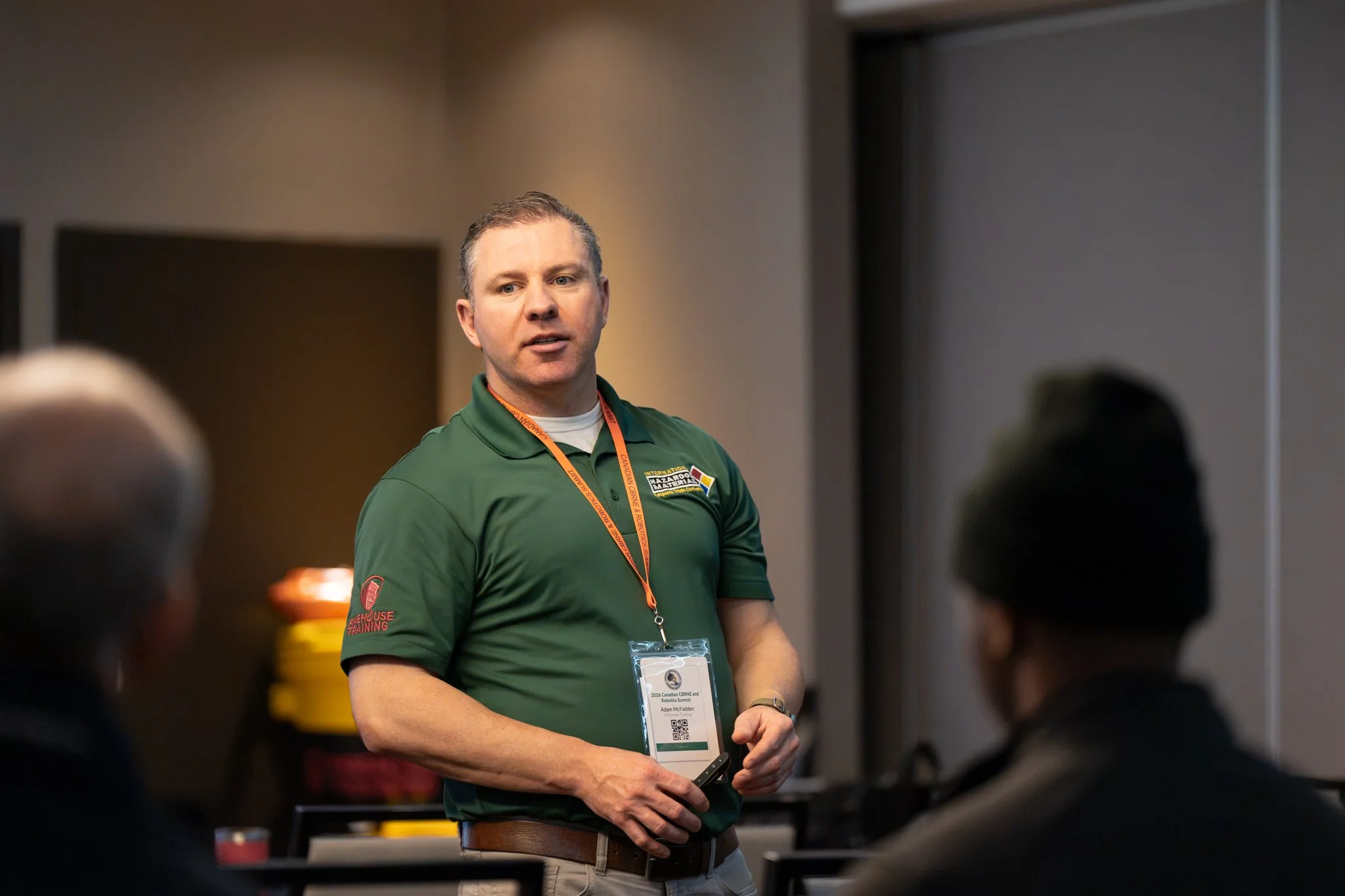
THE FIRE is USUALLY THE SECOND THING THAT HAPPENS.
Photograph by DIGRUCC.IO at the 2026 Canadian CBRNE & Robotics Summit
By the time you see fire, the most dangerous part of the call may already be behind you.
Here's the thing most people get wrong about a lithium-ion battery fire: the fire is usually the second thing that happens.
Before a failing cell ignites, it vents.
It pushes out a cloud of hot electrolyte vapor — flammable, toxic, and easy to mistake for ordinary smoke or a little haze in a stairwell. There's no flame yet. That's the trap: the vapor is the fuel. If it finds an ignition source in a closed space, you don't get a fire — you get an explosion. Crews have taken these blasts in apartments, garages, and parking structures, the flame arriving after the room was already full of fuel.
How fast?
UL's Fire Safety Research Institute put a failing e-scooter in a closed bedroom and clocked roughly 20 seconds from the first wisp of smoke to the battery gas exploding and blowing the window out. In a living-room test, the vented gas lit within 10 seconds. That's not "evacuate the floor." That's the length of one radio transmission.
Then there's the part nobody feels on scene.
Thermal runaway throws off hydrogen fluoride — somewhere between 20 and 200 milligrams for every watt-hour of battery. HF doesn't behave like smoke. It absorbs straight through skin and lungs, strips the calcium and magnesium out of your tissue, and the damage can take hours or even weeks to surface. You can walk off one of these calls feeling fine and be injured. For a CBRNE crew, it's closer to a chemical exposure than a fire — and the people reporting burns and airway irritation afterward are almost always the ones who pulled SCBA during overhaul. Keep it on. Treat the runoff as contaminated.
A few things worth un-learning while we're here:
Cold isn't safer — it's worse. Damaged batteries get more volatile in the cold, which is exactly why the TTC pulls e-bikes off the system every winter.
You can't eyeball a bad one. A counterfeit "UL" mark costs pennies. The pack that levels an apartment looks identical to the one that doesn't.
The white smoke is fuel, not exhaust. It's vaporized electrolyte. Treat it like a gas leak, because that's what it is.
And once it's running, you're not putting it out — you're managing it.
Thermal runaway doesn't stop on command; water cools the neighbouring cells to slow the chain, and that takes volume — a single EV pack can drink past 8,000 gallons. "Out" is a word the scene will lie to you about. Reignition risk runs 24 to 72 hours, and EVs have relit on the tow truck and in the impound lot. The camera stays on the pack until it's genuinely cold — not until the flames are gone.
None of this is rare anymore.
Toronto Fire ran 91 of these calls in 2025 and was already past 86 by mid-August this year — the fastest-growing fire risk in the city. The batteries are reaching us faster than the rules are.
Know what's behind the door. And know that the fire might be the least of what's waiting.
Sources
Off-gassing/venting precedes flame; vapor is flammable electrolyte; explosion can occur before fire — Justrite, "Causes of Lithium-Ion Battery Fires"; Firehouse, "Li-Ion Battery Heat Release Rate and Explosion Hazards" (Feb 2025): https://www.firehouse.com/operations-training/article/55252277/fire-department-response-lithium-ion-battery-heat-release-rate-and-explosion-hazards
~20-second bedroom test / 10-second living-room ignition — UL's Fire Safety Research Institute (FSRI), reported via Flashpoint Safety (May 2026): https://flashpointsafety.com/blogs/insights/what-early-warning-means-in-battery-safety
Hydrogen fluoride 20–200 mg/Wh; explosion + toxic off-gas hazards; stranded energy / delayed reignition — Etica AG, "BESS Firefighter Safety: A First Responder Guide" (Jun 2026): https://eticaag.com/bess-firefighter-safety-a-first-responder-guide/
HF absorbs through skin/lungs, depletes calcium/magnesium, delayed systemic effects — TT Club, "Fire not the only danger with lithium-ion batteries": https://www.ttclub.com/news-and-resources/news/article/fire-not-the-only-danger-with-lithium-ion-batteries/
Once thermal runaway starts it can't be stopped; off-gas as earliest warning — FM, "What businesses should know about lithium-ion off-gas detection" (Feb 2026): https://www.fm.com/insights/what-businesses-should-know-about-lithium-ion-off-gas-detection
Water cools rather than extinguishes; 8,000+ gallons on one EV; reignition 24–72 hours; SCBA through overhaul — FirefighterNow (Mar 2026): https://firefighternow.com/lithium-ion-battery-fires-firefighters/
Toronto Fire counts, "fastest-growing fire risk," cold/TTC winter ban rationale — CBC News / Radio-Canada (Aug 2026): https://www.cbc.ca/news/canada/toronto/lithium-ion-e-bike-fires-9.7311576
